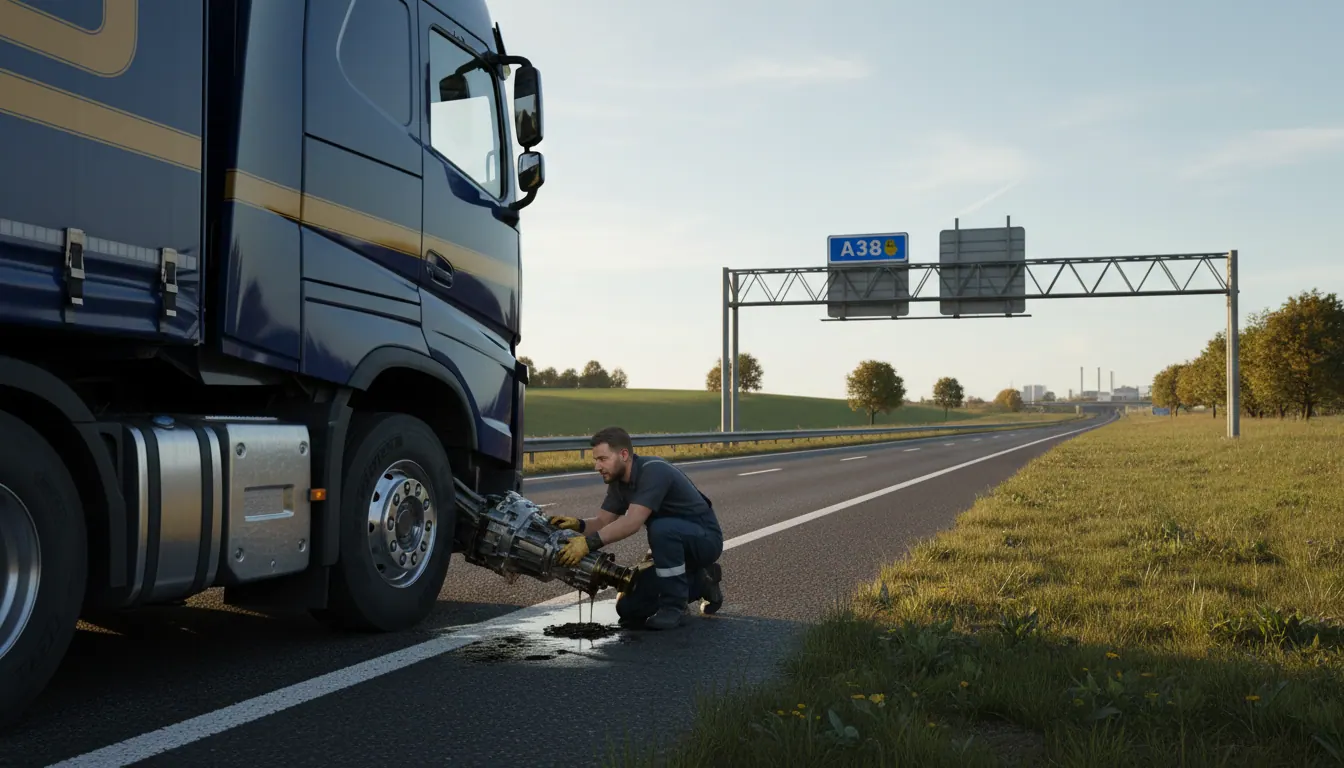
Cab and cargo area electrical faults on HGVs: diagnosing warning lights and preventing mid-route failures
Warning light on your truck? We diagnose HGV electrical faults at the roadside across the East Midlands and South Yorkshire, 24/7. Call us on 01332 916028.

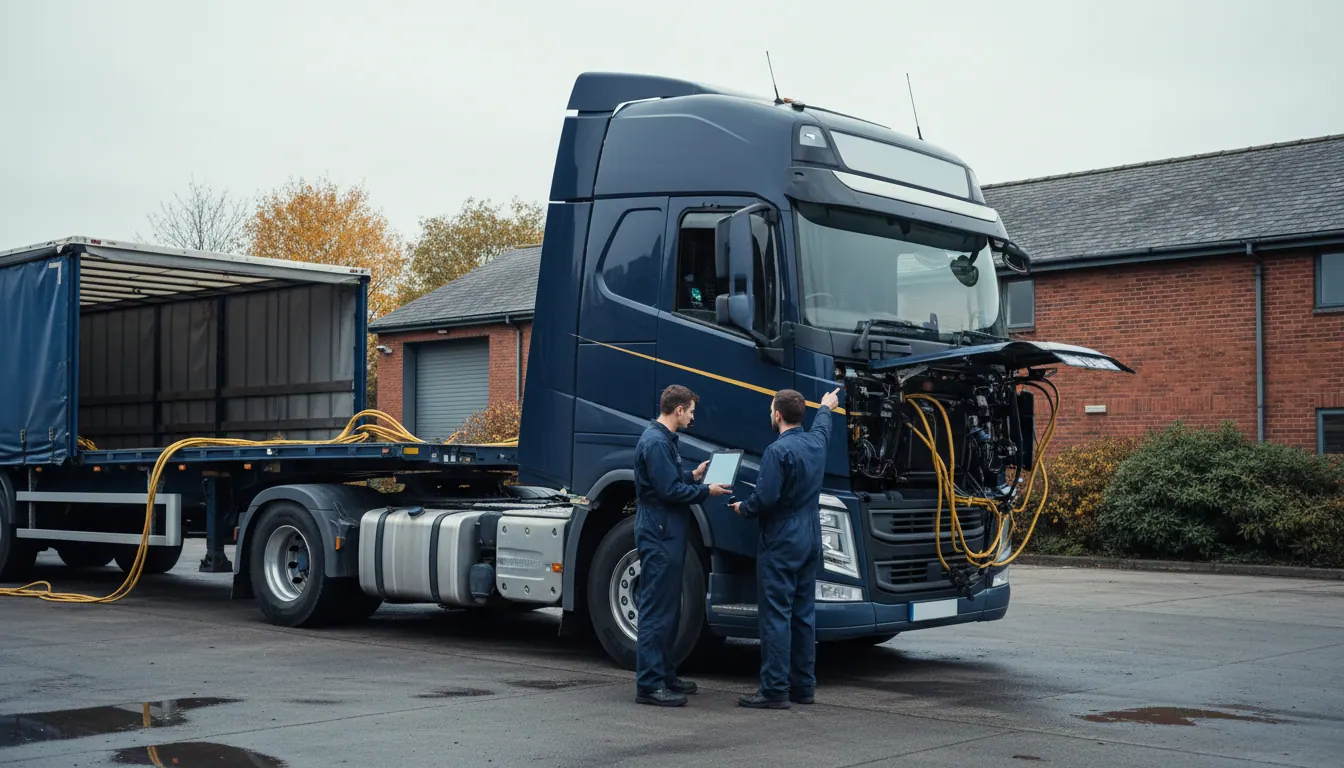
When a warning light comes on, the clock starts ticking
A single amber or red warning light on the dash can mean anything from a minor sensor glitch to a fault that will ground your vehicle at the next DVSA stop. For a driver on the M1 near Derby at 06:00 on a cold morning, or a fleet manager watching a vehicle go off route on the A50, the question is always the same: what is it, and can we fix it before it costs us the day?
That is exactly the situation we deal with every day. Our 24/7 breakdown line is answered around the clock, 365 days a year, and our technicians attend with fully equipped mobile units so we can diagnose and repair at the roadside wherever the fault allows.
What HGV electrical fault diagnosis actually involves
Modern trucks are not simple machines. Engine management, AdBlue/SCR systems, ABS, EBS, trailer electrics, tachograph circuits, lighting, air management and body electrics all talk to each other through CAN bus networks. When something goes wrong, the ECU logs a fault code, and a warning light appears on the driver's cluster.
The warning light is not the fault. It is the symptom. Proper HGV electrical fault diagnosis means connecting professional-grade diagnostic equipment to read the live fault codes, cross-referencing those codes with the actual system behaviour, and then tracing the root cause rather than just clearing the code and hoping.
Common electrical faults we see on HGVs and trailers across the East Midlands include:
- AdBlue/SCR system warnings triggering a speed or power deincentive, often caused by NOx sensor failure, dosing pump issues or contamination
- ABS and EBS fault codes on both tractor units and trailers, frequently traced to wheel speed sensors, reluctor rings or wiring damage
- Engine management lights covering EGR faults, DPF regeneration failures, turbo actuator issues and fuel system sensors
- Lighting and electrical supply faults on trailers, including 7-pin and 15-pin socket failures, corroded connectors and broken earth returns
- Tachograph and driver card errors that need careful diagnosis to separate a genuine unit fault from a wiring or power supply issue
- Alternator and charging system warnings, which can strand a vehicle far faster than drivers expect if ignored
Some of these can be resolved at the roadside. Others need a workshop visit, but even then, accurate roadside diagnosis means we arrive at the workshop knowing exactly what is needed rather than spending time fault-finding from scratch.
Why roadside diagnosis matters more than ever for DVSA compliance
A vehicle presenting a fault light is a risk on two fronts. First, there is the obvious operational risk: the fault may worsen, the vehicle may lose power or stop altogether. Second, there is the compliance risk. DVSA roadside examiners have the authority to prohibit a vehicle on the spot if a fault is deemed to affect roadworthiness, and an unresolved warning light is often the starting point for a deeper inspection.
For operators running under an O-licence in the East Midlands and South Yorkshire, a prohibition notice feeds directly into your OCRS score. Enough of those and your licence comes under scrutiny. Getting a fault properly diagnosed and documented, rather than cleared and ignored, is part of running a compliant operation.
If you want to understand how electrical health fits into the broader picture of keeping vehicles roadworthy, our article on alternator and battery checks for HGV fleets covers the charging system side in detail, and our guide on MOT preparation for HGVs explains how unresolved faults translate into test failures.
Covering the routes where breakdowns actually happen
We work across the East Midlands and South Yorkshire, covering the key commercial corridors: the M1 from the Derbyshire border up through Nottinghamshire and South Yorkshire, the A38 north and south of Derby, the A50 across to Stoke and the Staffordshire border, the A42 down towards the M42, and the A52 through Derby itself.
These are busy routes. Distribution hubs, manufacturing sites, logistics parks and intermodal terminals all feed onto them. When a vehicle goes down on any of these roads, the pressure to recover the situation quickly is real. A trailer with a faulty ABS sensor sitting on the hard shoulder of the M1 is not just a breakdown. It is a potential prohibition, a missed delivery window and a driver waiting in the cab.
Our technicians operate from our base at Calk Mill Farm, Ashby Road, Melbourne, Derby, DE73 8BJ, which puts us well placed for rapid attendance across this patch. Workshop hours for planned work run Monday to Friday, 07:30 to 17:00, but the emergency line runs 24/7 without interruption.
What happens when you call us with an electrical fault
When you call us on the breakdown line, we ask the right questions straight away: what warning light, what vehicle make and model, what the driver is experiencing, and where exactly the vehicle is. That information lets us bring the right diagnostic equipment and, where possible, the right parts.
Our technicians do not arrive with a generic code reader and a shrug. They attend with equipment capable of deep diagnostics across the major truck manufacturers, including Volvo, DAF, Mercedes, MAN, Scania and Iveco. For trailer electrics, we cover the full range of trailer types running on East Midlands and South Yorkshire routes.
Where a fault can be cleared safely and the vehicle made roadworthy at the roadside, we do that. Where the fault requires workshop attention, we give you an honest assessment on the spot and recover the vehicle to our workshop if needed, rather than leaving you to arrange a second call-out.
What our customers say about how we work
The people who call us are running vehicles as a business. They understand that downtime is money, and they need a team that understands that too.
The guys here are brilliant very accommodating no job to big or small, they work fast and to a very high standard as in this business a vehicle of the road is lost money and they understand this.
Highly recommend 👌
horizontravelgroup, 5★
That attitude runs through everything we do. Electrical fault diagnosis is not a job to rush, but it is a job to get right, first time, so the vehicle is back earning rather than sitting.
Planned maintenance as the first line of defence
Most electrical faults on HGVs do not appear without warning. Sensor degradation, corroded connectors, failing relay boards and weakening alternators all give signs before they cause a breakdown. The problem is that those signs are easy to miss without a structured inspection process.
Our PMI safety inspections and planned preventative maintenance schedules are designed to catch these issues before they become roadside emergencies. A technician working through a vehicle systematically will spot a corroding 7-pin socket, a fraying loom run or a sensor reading at the edge of its tolerance before the ECU logs a fault code and lights up the dash at 05:30 on a delivery morning.
For operators thinking about how to structure that kind of proactive maintenance, our article on planned preventative maintenance for HGV fleets sets out the practical case clearly. And if you are weighing up whether a fleet maintenance contract makes sense for your operation, take a look at our piece on fleet maintenance contracts versus pay-as-you-go repairs.
Frequently asked questions
What does it mean when my truck's engine management light comes on?
An engine management light means the ECU has logged one or more fault codes. The cause could range from a minor sensor reading outside normal parameters through to a serious engine or emissions system fault. The only way to know is to connect diagnostic equipment and read the live codes. Do not assume it is minor and do not clear the code without understanding what caused it, especially before a DVSA inspection or MOT.
Can you diagnose HGV electrical faults at the roadside, or does the vehicle need to come to a workshop?
Most fault diagnosis can be carried out at the roadside. Our technicians attend with professional-grade diagnostic tools capable of reading and interpreting fault codes across the main truck makes. Many faults can also be repaired at the roadside. Where a workshop repair is needed, we will tell you that clearly and arrange recovery if required.
My truck has an AdBlue warning and is threatening to derate. What should I do?
An AdBlue derate warning is time-sensitive. The SCR system is part of your emissions compliance, and if the fault is not resolved the vehicle's ECU will progressively limit engine power. Pull over safely, call us on the breakdown line, and do not attempt to just top up the AdBlue tank without understanding the underlying fault. The issue is often the NOx sensor, the dosing unit or a contamination problem rather than simply a low fluid level.
Does a warning light automatically fail an HGV MOT or DVSA inspection?
Not automatically, but it is a serious risk. An illuminated MIL (malfunction indicator lamp) relating to emissions systems will typically result in a test failure. Other warning lights may lead to a more detailed inspection. The safest approach is to have any active warning light diagnosed and resolved before presenting the vehicle for test.
Get in touch
If you have a warning light on a truck, trailer or van and you need it diagnosed properly, call us on 01332 916028. We answer 24 hours a day, every day of the year. Tell us where you are and what the vehicle is showing, and we will get the right technician to you.
“Took my preserved bus into here and my car for work to be done ,great service,fast and efficent, good prices will definitely use again highly recommend 👍”
Ready when you are
Call us- Alternator and battery checks for HGV fleets: why autumn servicing prevents breakdown call-outs
- Planned preventative maintenance for HGV fleets: why scheduled checks beat emergency callouts on the A42 and M1
- MOT preparation for HGVs: what fails and how to avoid downtime before your test date
- Fleet maintenance contract vs. pay-as-you-go repairs: what works for East Midlands operators