Alternator and battery checks for HGV fleets: why autumn servicing prevents breakdown call-outs
Autumn battery and alternator checks for HGVs across East Midlands and South Yorkshire. Keep your fleet running on the M1, A38 and A50 this season.

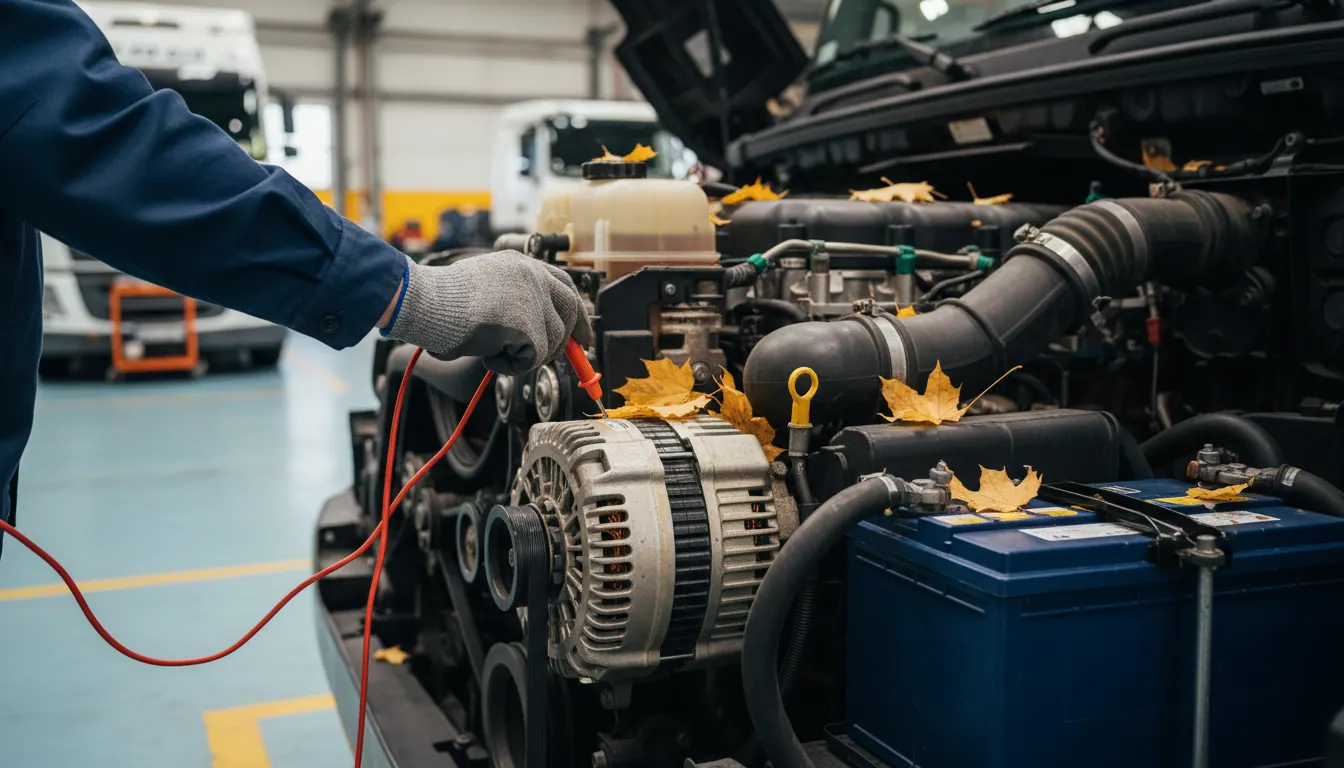
Why autumn is the crunch point for HGV batteries and alternators
Cold mornings arrive quickly in the East Midlands. One week you are running fine; the next, a driver is calling in from a layby off the A38 or sitting dead on a trading estate in Sinfin because the engine will not turn over. It happens every year, and it almost always traces back to a battery or alternator that was already struggling but never flagged.
This is not about bad luck. It is about a predictable seasonal pattern that fleet engineers and transport managers can get ahead of, rather than react to at 05:30 on a dark October morning.
We work on HGVs, trailers and commercial vehicles across East Midlands and South Yorkshire, attending breakdowns on the M1, A38, A50, A42 and A52. Every autumn, battery and charging faults account for a significant share of the roadside calls we attend. This guide sets out exactly what to check, when to check it, and what the warning signs look like before a fault becomes a breakdown.
How cold weather exposes a battery that is already weak
A healthy, fully charged battery at 25°C has substantially more cranking capacity than that same battery at 0°C. The chemistry slows down. The oil in the engine is thicker. The starter motor draws more current. Everything conspires against a marginal battery at the same moment.
The problem is that a battery can test acceptable in September and fail entirely by November. The capacity fades gradually, and the load increases sharply once temperatures drop. Drivers often report that the engine "seemed a bit slow to start" for a few mornings before it refused entirely. That slow crank is the warning.
Key signs a battery is approaching the end:
- Sluggish or slow cranking, especially on first start of the day
- Interior lights or dash lights dimming noticeably on start-up
- Battery warning light flickering, particularly at low revs or idle
- The vehicle needs a jump start after a short overnight stop
- Batteries that are more than three to four years old and have never been load-tested
If your drivers are reporting any of these and you have not had the battery load-tested, that vehicle is a breakdown waiting to happen on the M1 or the A50.
The alternator's role and why it fails quietly
The alternator keeps the battery charged while the engine runs and powers the vehicle's electrical systems. When it starts to fail, the battery drains steadily. The driver may not notice anything obvious for days, because the battery holds enough charge for one or two starts. Then it does not.
Common alternator failure signs on HGVs:
- Battery warning light on the dash (do not ignore this)
- Electrical systems behaving oddly: headlights flickering, instrument cluster glitching, ABS or EBS warning lights appearing without obvious cause
- Battery going flat overnight even after a full day's running
- Burning smell from the engine bay, which can indicate a slipping drive belt
- Voltage reading below 13.5V at idle on a healthy system (a fully functioning alternator typically holds 13.8V to 14.4V at the battery terminals)
An alternator fault is often misdiagnosed as a battery fault. The battery gets replaced, the vehicle runs for a week, then goes flat again. The root cause was the alternator not charging. Proper diagnosis with a calibrated voltmeter and load tester identifies which component is actually at fault before you spend money on the wrong part.
What a proper pre-autumn battery and alternator check covers
A thorough check is not just a visual inspection. Here is what we carry out when a vehicle comes in for autumn electrical health checks at our workshop at Calk Mill Farm, Ashby Road, Melbourne, Derby, DE73 8BJ, or when we attend on-site at a depot:
-
Battery load test. A load tester applies a controlled current draw and measures how the battery holds voltage under load. A battery that reads 12.6V at rest but drops sharply under load is failing, even if it looks fine on a multimeter.
-
Alternator output test. We check voltage at the battery terminals with the engine running, then add electrical loads (headlights, blower, heated rear screen on applicable vehicles) to see whether the alternator maintains output under real demand.
-
Drive belt inspection. The alternator is driven by a belt. A cracked, glazed or loose belt will cause intermittent charging faults that are easy to miss. Belts are cheap to replace; alternators are not.
-
Battery terminal and earth strap condition. Corroded terminals increase resistance and reduce the effective charging and cranking current. On older vehicles, the earth strap from the battery to the chassis is a common weak point.
-
Battery age and service history. If there is no record of when the battery was fitted, that is worth knowing. An unknown-age battery on a vehicle doing daily trunk runs on the A38 or M1 is a risk.
Overnight battery drain: what causes it on HGVs
This is one of the questions we hear regularly from operators. A truck is parked up overnight with a healthy battery reading, and by morning it will not start.
The most common causes:
- Parasitic draw from auxiliary systems. Fridge units, tracking devices, tachograph systems, cab heating and inverters all draw current when the engine is off. On a weak battery, this overnight drain is enough to prevent a cold-weather start.
- Faulty isolator switch. If the isolator is not cutting current properly, the battery drains regardless of whether the driver has isolated correctly.
- Failing battery that cannot hold charge. A battery that has lost internal capacity will discharge faster under the same parasitic load.
- Alternator not fully recharging during the day's run. Short urban runs or a lot of idle time means the alternator never fully replenishes what the starter motor used.
The fix depends on the cause. Diagnosis first, then repair.
What our customers say
The team at horizontravelgroup put it plainly:
"The guys here are brilliant very accommodating no job to big or small, they work fast and to a very high standard as in this business a vehicle of the road is lost money and they understand this."
That last point matters. A vehicle off the road is not just an inconvenience; it is a missed delivery, a failed collection, a driver sitting idle and a potential operator licence issue if the fault relates to roadworthiness. We approach every callout with that in mind, whether it is a battery fault on a curtainsider on the A52 or an alternator replacement at a depot near Sheffield.
Fleet contracts and planned maintenance: the smarter approach
Reacting to a dead battery at 05:00 on the M1 costs more than preventing it. A fleet maintenance contract means we schedule regular checks, including electrical health, as part of a planned visit rather than an emergency callout.
For operators running multiple vehicles across South Yorkshire and the East Midlands, a contract approach means:
- Batteries and alternators are load-tested at defined intervals
- Ageing components are replaced before they fail on the road
- Your OCRS score is not damaged by a preventable roadside defect
- Drivers are not starting shifts with unreliable vehicles
If you want to understand how planned maintenance compares to reactive callouts in real cost terms, our article on fleet maintenance contracts versus pay-as-you-go repairs covers this in detail for East Midlands operators.
For vehicles approaching their next inspection date, it is also worth reading our PMI safety inspection checklist to understand what DVSA looks for and how electrical system condition feeds into roadworthiness.
Frequently asked questions
Why does my truck battery drain so quickly overnight?
The most common causes are parasitic draw from auxiliary systems (fridge units, tracking, tachograph, cab heating), a faulty or poorly isolating battery isolator switch, a battery that has lost internal capacity and cannot hold charge, or an alternator that is not fully recharging the battery during the day's running. Diagnosis with a load tester and a current clamp identifies which is responsible.
How do I know if my HGV alternator is failing?
Watch for a battery warning light that stays on or flickers, electrical systems behaving erratically, a battery that goes flat after a full day's running, or a voltage reading below 13.5V at the battery terminals with the engine running. A burning smell from the engine bay can also indicate a slipping alternator drive belt. If you see any of these, get it tested before the vehicle goes out on the A38 or M1.
How often should HGV batteries be tested?
As a minimum, a load test before the onset of cold weather (so September or October) and again in early spring makes sense for vehicles in daily commercial use. Any battery over three years old should be tested at every service interval. If a vehicle has had a no-start incident, the battery and alternator should both be tested before the vehicle returns to service.
Can a failing alternator damage the battery?
Yes. An alternator that overcharges (voltage consistently above 14.8V) will shorten battery life significantly and can cause internal damage. An alternator that undercharges means the battery is never fully replenished, which accelerates sulphation inside the cells and reduces capacity over time. Getting both components tested together is the only reliable way to understand the health of the charging system as a whole.
Get your fleet checked before the cold mornings arrive
If you are running HGVs or commercial vehicles across East Midlands and South Yorkshire and you have not had batteries and alternators checked this autumn, now is the right time. Our workshop at Calk Mill Farm handles planned work Monday to Friday, 07:30 to 17:00, and our breakdown line is answered 24 hours a day, 365 days a year for emergencies.
Do not wait for a driver to call in from the hard shoulder on the M1 at J25 on a November morning. Call us on 01332 916028 and we will get the checks booked in.
“Took my preserved bus into here and my car for work to be done ,great service,fast and efficent, good prices will definitely use again highly recommend 👍”