Lights and visibility on HGVs before winter: DVSA checks, LED conversions and roadside repairs for trailers
Trailer lighting faults are a leading cause of DVSA prohibition notices. We explain what inspectors look for and how we help East Midlands fleets stay compliant.

Trailer lights and DVSA roadworthiness: why this fault category keeps catching operators out
Trailer lighting failures sit near the top of the list when DVSA examiners issue prohibition notices at the roadside. It is not because operators are careless. It is because trailer lights take a battering every day, connectors corrode, sockets crack, and the faults often develop slowly enough that a driver misses them on the morning walk-round. By the time a DVSA officer pulls the unit over on the M1 or the A38, the vehicle is already at risk of an immediate prohibition and a mark against the operator's OCRS score.
We see this regularly across the East Midlands and South Yorkshire. Fleets running tight schedules on the A50, the A42 and the M1 corridor cannot afford the delay, and they certainly cannot afford the compliance hit. So this article covers what DVSA actually looks for, where the common faults hide, and what you can do to keep your trailers legal and rolling.
What DVSA checks when it comes to trailer lighting
DVSA roadworthiness inspections cover every lighting circuit on a trailer. Examiners are not just looking at whether a bulb works. They check:
- Rear marker lights, stop lights and tail lights
- Indicator function and flash rate (too fast or too slow both fail)
- Reverse lights and fog lights
- Side marker lights on trailers over a certain length
- Reflectors, including their condition and positioning
- The condition of the electrical supply line (the seven-pin or fifteen-pin connector and the lead itself)
- Lamp lenses for cracks, moisture ingress and discolouration that reduces light output
A lamp that is physically present but emitting less than the required light output still fails. A lens that has yellowed or cracked enough to affect visibility is a defect. These are the details that catch operators off guard, because the light appears to work when the driver tests it in a yard at 06:30 on a grey morning.
The most common trailer lighting faults we diagnose
Corrosion in the seven-pin socket is probably the single most frequent fault we find during trailer checks. The socket sits exposed to road spray, salt and moisture throughout the year. Pins corrode, connections become intermittent, and the trailer behaves perfectly on one journey and then shows a fault warning the next. An intermittent fault is actually harder to catch than a complete failure, because it may not show on the driver's dashboard indicator check.
Other faults we find regularly:
- Cracked lamp housings that allow water ingress, leading to short circuits and bulb failure
- Damaged cable looms along the trailer underframe, often caused by contact with debris or poor routing after a previous repair
- Blown fuses on the tractor unit that affect trailer lighting circuits without any obvious sign to the driver
- LED conversions wired incorrectly, where the flash rate or load resistance is wrong for the tractor unit's flasher relay
- Marker light failures on curtainsider and box trailers, which are easy to overlook because they are not part of the standard pre-drive check most drivers run
Why OCRS exposure matters more than just a fixed penalty
A single roadside prohibition does not just cost you a delay and a repair bill. It feeds into your Operator Compliance Risk Score. A worsening OCRS increases the likelihood of further targeted enforcement, which means more stops, more inspections and more disruption to your operation. Transport managers running fleets on the A52 corridor out of Derby, or on the M1 between junctions 23 and 30, will know how visible those routes are to DVSA enforcement.
Keeping trailer lighting in good order is not just about avoiding a fine. It is about protecting the operator licence that your entire business depends on.
Walk-round checks: what drivers should actually be looking for
The legal requirement for a daily walk-round check is well known. The reality is that trailer lighting checks are often rushed, particularly on early starts when light is poor and schedules are tight. A few practical steps make a real difference:
- Check all lights with the ignition on and a second person watching from the rear, not just the dashboard warning light
- Walk the full length of both sides of the trailer to check marker lights, not just the rear cluster
- Inspect the seven-pin connector visually for bent pins, cracking or corrosion before coupling
- Check the cable lead for chafing or damage along its length
- Look at lens condition, not just whether the light illuminates
If your drivers are working from a written defect report sheet, the trailer lighting section should be specific. A tick-box that says "lights checked" is not the same as a record that confirms each circuit was tested.
What we do when we find a trailer lighting fault
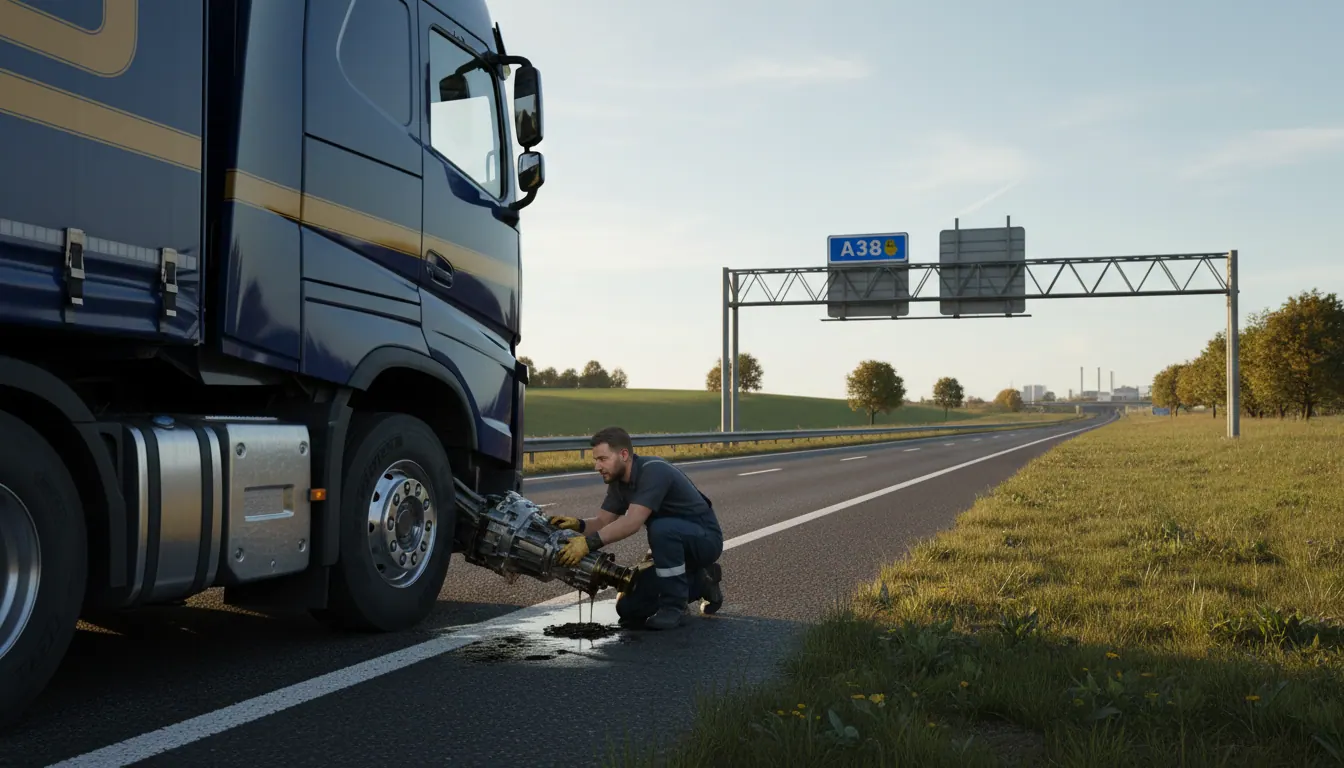
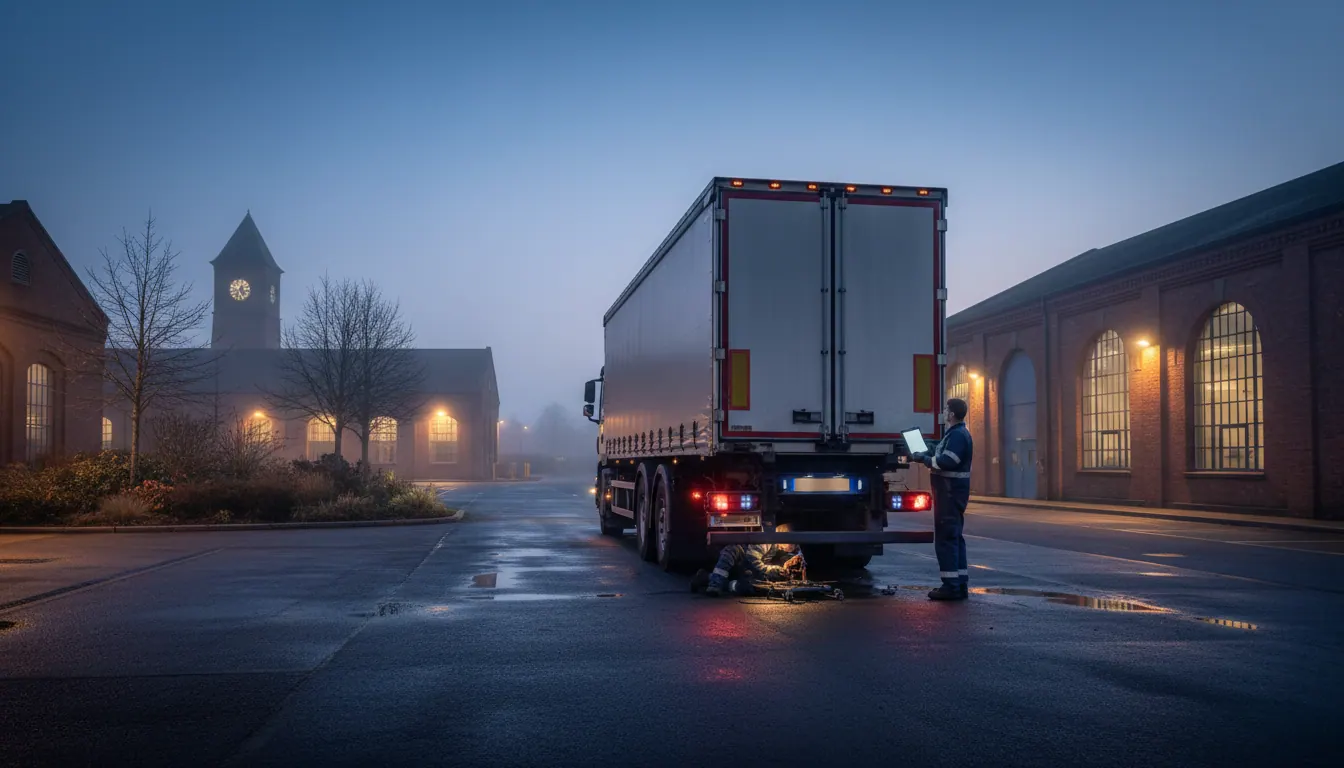
Our technicians attend fully equipped for roadside diagnosis and repair. When we get a call about a trailer lighting fault, whether it is a driver stranded on the A38 or a fleet manager who has found a defect during a yard check, we aim to diagnose and fix at the roadside wherever possible rather than towing the unit away.
For straightforward faults like a failed bulb, a corroded connector or a cracked lens, a roadside repair is usually achievable. For more complex issues such as loom damage or wiring faults introduced by a previous repair, we may need to bring the trailer to our workshop at Calk Mill Farm, Ashby Road, Melbourne, Derby, DE73 8BJ, where we have the space and equipment to work through the full circuit properly.
We also pick up trailer lighting faults during PMI safety inspections and MOT preparation work. Catching them at that stage, before a DVSA examiner does, is always the better outcome.
What a real operator says
This reflects the kind of relationship we build with operators who run commercial vehicles day in, day out:
We use Trucktek for our maintenance, great bunch of guys with fountains of knowledge. Highly recommended.
That review came from Minibus Experts. It captures something we hear often: operators want a team that actually understands commercial vehicles, not a generalist garage that treats an HGV or a trailer as an oversized car. Trailer lighting faults, air system issues, brake defects, all of these require specific knowledge of how the vehicle is built and how DVSA will assess it.
How trailer lighting fits into a broader compliance picture
Lighting faults rarely exist in isolation. A trailer that has not been maintained regularly tends to accumulate defects across multiple systems. We often find lighting issues alongside brake wear, air line condition concerns or bodywork damage that affects reflector positioning. That is why a proper PMI safety inspection covers the full vehicle, not just the items on a driver's walk-round list.
If you want to understand what DVSA looks for across the full range of systems, our article on PMI safety inspection checklist: what DVSA looks for and how to prepare your HGV or trailer covers the process in detail.
For fleets that want to reduce the risk of being caught out by any roadworthiness issue, including lighting, planned preventative maintenance for HGV fleets: why scheduled checks beat emergency callouts on the A42 and M1 explains how a structured maintenance programme keeps defects from building up.
Frequently asked questions
What trailer lighting faults cause an immediate prohibition at DVSA inspection?
Any lighting defect that makes the vehicle dangerous to other road users can result in an immediate prohibition. In practice, this includes non-functioning stop lights, missing or inoperative rear marker lights, and indicators that do not flash or flash at the wrong rate. A lamp that is present but clearly not working to the required standard, such as one with severe lens discolouration, can also be treated as a defect rather than a minor item.
Can a trailer lighting fault affect my operator licence?
Yes. Roadside prohibitions are recorded and contribute to your OCRS score. A pattern of lighting defects suggests to DVSA that your maintenance systems are not working, which can trigger a formal investigation and, in serious cases, put your operator licence at risk. Keeping a clear record of defect reports and repairs is part of demonstrating that your maintenance regime is effective.
How do I know if my trailer's seven-pin connector is causing intermittent lighting faults?
Intermittent faults are often connector-related. Signs include lights that work correctly in the yard but show warnings on the road, dashboard indicators that flicker without a clear cause, or lamps that fail on one side only. A proper electrical test of the connector and the supply line, rather than just a visual check, is needed to confirm the fault. Our technicians carry diagnostic equipment to test trailer circuits at the roadside.
Do you cover trailer lighting repairs on the M1 and A38 in the East Midlands?
Yes. We cover the M1, A38, A50, A42 and A52 corridors across East Midlands and South Yorkshire. Our emergency breakdown line is answered 24 hours a day, 365 days a year. If your trailer develops a lighting fault at the roadside, call us and we will get a technician to you as quickly as possible to assess and repair on-site where the fault allows.
Get in touch
If you have a trailer with a lighting fault, a fleet due for its next PMI, or a vehicle you want checked before a DVSA inspection, call us on 01332 916028. Our workshop runs planned work Monday to Friday, 07:30 to 17:00, and our emergency line is always answered. Tell us what you have and where you are, and we will work out the quickest way to get it sorted.