Timing belt and wet belt warnings on trucks: what your dashboard is telling you before MOT failure
HGV timing belt warning light on? We diagnose and repair belt failures across the East Midlands and South Yorkshire. Call us 24/7 on 01332 916028.

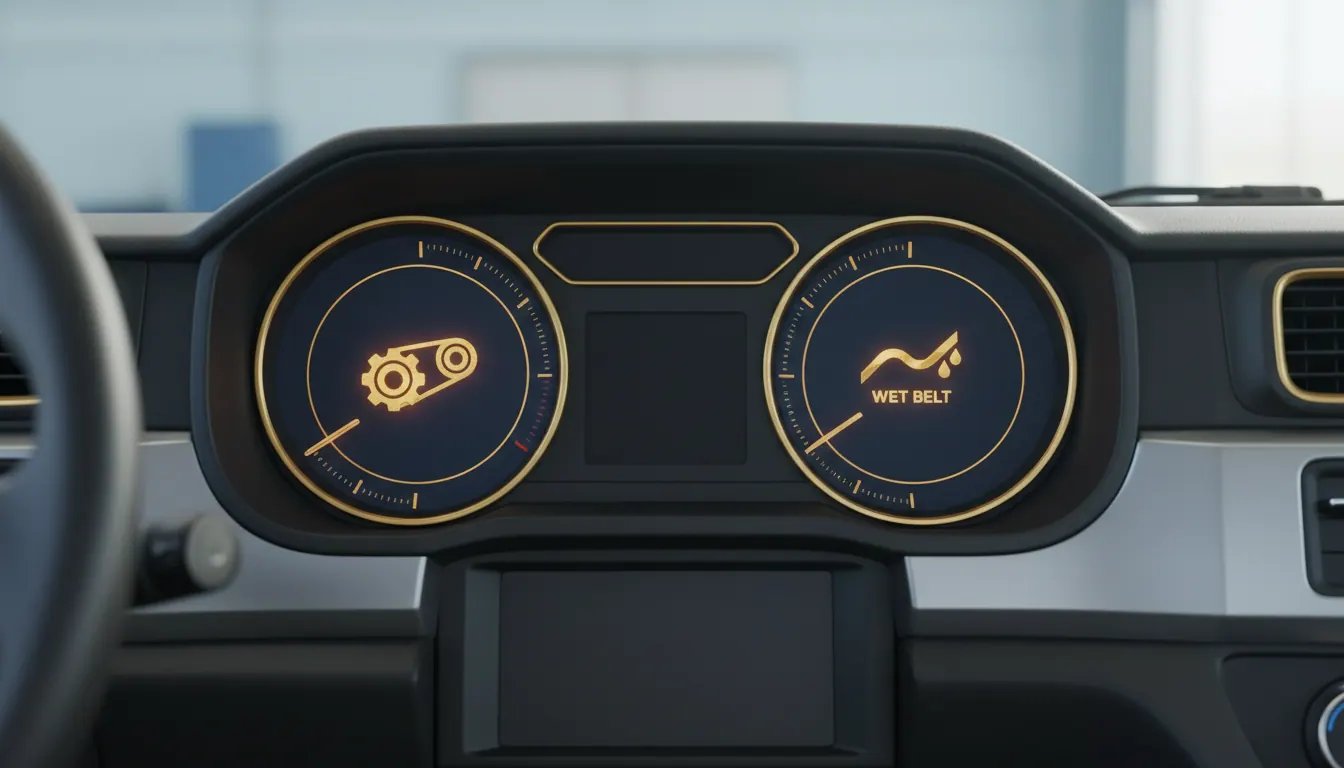
When that warning light comes on, time is not on your side
A timing belt warning light on an HGV or heavy commercial vehicle is not something to park at the back of your mind until the next service. It is telling you something is wrong with one of the most critical systems in the engine, and ignoring it can turn a manageable repair into a full engine rebuild.
We see this across the East Midlands and South Yorkshire regularly. Drivers running the M1, A38, A50 and A42 corridors spot a warning light, carry on to the next drop, and then either lose the engine entirely or limp in with damage that goes well beyond the belt itself. The fault is rarely just the belt.
This article explains what the warning light actually means, what causes timing belt failure on HGVs, and what to do if it comes on when you are out on the road.
What the timing belt warning light is actually telling you
On most modern HGVs and heavy commercials, including Mercedes, DAF, Volvo and MAN units, the engine management system monitors timing-related sensors throughout the engine. When the ECU detects that the crankshaft and camshaft are no longer in the correct relationship, it logs a fault and triggers a warning light. That relationship is controlled by the timing belt (or timing chain, depending on the engine).
The light itself does not always say "timing belt". It often appears as a general engine management warning, sometimes alongside a specific fault code when you plug in diagnostics. On some Peugeot-engined vehicles and Mercedes units, the fault can be misread as a sensor issue when the root cause is belt wear or stretch.
This is why proper diagnostics matter. Reading the fault code is only the start. You need to understand what drove the code.
What causes timing belt failure on HGVs?
There is no single cause. In our experience, the most common factors are:
- Interval overrun. The belt has simply done more hours or miles than it should have without replacement. This is the most avoidable cause and still one of the most common.
- Oil contamination. A leaking cam seal or front crankshaft seal can soak the belt in oil, degrading the rubber and causing it to slip or skip teeth.
- Tensioner and idler failure. The belt does not run in isolation. If the tensioner loses pressure or an idler pulley seizes, the belt can lose tension and jump timing.
- Water pump failure. On many HGV engines, the water pump is driven by the timing belt. If the pump seizes, it can destroy the belt in seconds.
- Incorrect installation. A belt fitted without proper tensioning or with incorrect timing marks will fail early and cause immediate running problems.
On older Mercedes and Peugeot-engined commercial vehicles in particular, we see contamination and tensioner issues regularly. These engines are not forgiving when the belt is even slightly out of specification.
Can you drive with a timing belt warning light on?
The short answer: no. Not if you want to protect the engine.
A timing belt that has jumped even one tooth will cause misfiring, rough running and potential valve-to-piston contact on interference engines. Many HGV diesel engines are interference designs, which means if the belt breaks while running, the valves and pistons will collide. That turns a belt replacement job into a cylinder head rebuild, or worse.
If the warning light comes on while you are moving, the safest course is to pull over somewhere safe as soon as you can, get the vehicle off the carriageway, and call for assistance. On the M1 between junctions 25 and 28, the A38 near Derby or the A50 heading east, there are lay-bys and service areas where you can get the vehicle clear of traffic.
Do not switch the engine off and on repeatedly trying to clear the light. Do not continue to the next drop hoping it will resolve itself. Get a diagnosis done before you move the vehicle further.
How we diagnose timing belt faults at the roadside
Our technicians attend fully equipped for roadside diagnostics. When we get to you, the first step is connecting to the vehicle's ECU to pull the fault codes and live data. We want to see what the crankshaft and camshaft position sensors are reporting and whether there is a timing offset.
From there, we carry out a visual inspection: belt condition, tension, tensioner operation, any signs of oil contamination around the front of the engine. On some jobs, we can carry out a belt replacement at the roadside. On others, where the engine needs to come down further or where there is damage to diagnose first, we will recover the vehicle to our workshop at Calk Mill Farm, Ashby Road, Melbourne, Derby, DE73 8BJ, where we have the space and equipment to do the job properly.
The goal is always to fix it where you are if we can. Recovery adds time and cost. A repair that gets you back on the road the same day is better for everyone.
The team at horizontravelgroup put it well:
The guys here are brilliant very accommodating no job to big or small, they work fast and to a very high standard as in this business a vehicle of the road is lost money and they understand this.
Highly recommend 👌
That is exactly the mindset we bring to timing belt and engine fault jobs. A truck off the road is money out of the business.
Timing belt replacement as part of planned maintenance
The best outcome is catching a worn belt before the warning light ever comes on. Timing belts on HGVs should be replaced at the manufacturer-specified interval, which is typically expressed in engine hours or kilometres depending on the vehicle. Some operators run extended intervals under oil analysis programmes, but that requires proper monitoring.
If you are running a fleet across the East Midlands or South Yorkshire, timing belt replacement should sit inside your planned preventative maintenance schedule. It is one of those jobs that is straightforward when planned and expensive when reactive.
Our workshop handles planned belt replacements as part of scheduled servicing. If you are unsure when your fleet's belts were last done, or if you have acquired vehicles where the service history is incomplete, we can carry out a condition inspection and advise on what needs doing.
For more on how planned maintenance reduces the risk of expensive roadside breakdowns, see our article on planned preventative maintenance for HGV fleets: why scheduled checks beat emergency callouts on the A42 and M1.
Timing belt faults and your DVSA compliance position
A timing-related fault that causes the engine to run rough or misfire will almost certainly trigger a prohibition if your vehicle is stopped by DVSA. An engine management warning light showing on the dashboard is a visible fault, and an examiner will not wave it through.
If you are heading towards a PMI or MOT date and a timing belt warning light is showing, get it resolved before the inspection. Presenting a vehicle with an active fault code is not just a fail risk, it reflects on your maintenance systems and your OCRS score.
We carry out MOT preparation and PMI safety inspections from our Melbourne workshop. We can identify timing and engine management faults as part of that process and advise on what needs addressing before your test date.
See also: MOT preparation for HGVs: what fails and how to avoid downtime before your test date.
Frequently asked questions
Would an engine warning light come on for a timing belt problem?
Yes. On most modern HGVs and heavy commercials, a timing belt issue will trigger the engine management light because the ECU detects a mismatch between the crankshaft and camshaft position sensors. The fault code logged may reference timing, but it can also appear as a sensor fault without a proper diagnosis. The light alone does not tell you which component has failed. You need diagnostics to find the root cause.
What is the main cause of timing belt failure on HGVs?
Interval overrun is the most common cause: the belt has simply not been replaced when it should have been. After that, oil contamination from cam or crank seals is a frequent culprit, followed by tensioner or idler pulley failure. On some engines, a failing water pump driven by the timing belt will destroy the belt before any other warning appears.
Can I carry on driving if I think my timing belt is failing?
No. If the warning light is on and you suspect a timing belt issue, stop the vehicle safely and get a diagnosis before driving further. Most HGV diesel engines are interference designs: if the belt breaks or jumps timing while the engine is running, the resulting damage goes well beyond the belt itself and can write off a cylinder head. The repair cost rises dramatically the further you drive.
How do I clear a timing belt warning light on an HGV?
You cannot simply reset the light and move on. The fault code needs to be read, the root cause identified and the fault repaired. Once the repair is complete, the code can be cleared and the system checked to confirm the fault is resolved. Clearing the code without doing the repair will just result in the light coming back on, and the underlying damage continuing.
Get in touch before a warning light becomes a written-off engine
If a timing belt warning light has come on, or if you want to get ahead of it with a planned belt change, call us on 01332 916028. We answer 24 hours a day, 365 days a year for breakdowns, and our workshop is available Monday to Friday for planned work. Tell us what the vehicle is, where you are, and what the light is showing, and we will advise you on the best next step.
“Pulled in by a wrecker with a knackered clutch on my daf about 1130. The lads were on the job as soon as the part came in and had in finished and back on the road by 1715. Cracking job only wish you could give more than 5* Thanks Nick, Kaleb and Ben for getting me sorted and back on the road the sam…”