HGV air system fault diagnosis: common failures, roadside repair and why they cause downtime
HGV air system fault diagnosis across East Midlands and South Yorkshire. Mobile roadside repair on M1, A38, A50 and A42. Call Trucktec Assist 24 on 01332 916028.

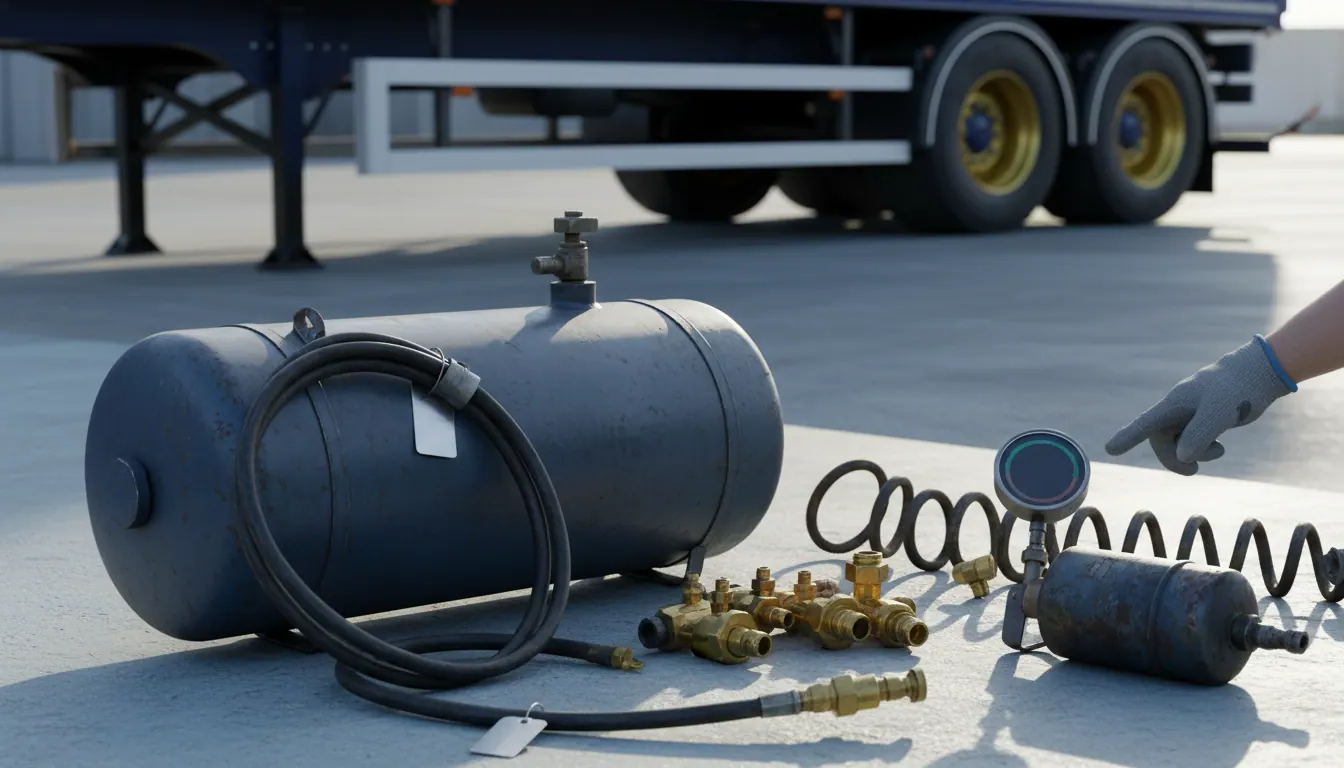
Air system faults ground trucks fast. Here is what to look for.
A dropping air gauge, a sticky brake, a compressor cycling non-stop. Air system faults on HGVs rarely announce themselves politely. They tend to surface at the worst possible moment: loaded, late, on the M1 northbound near Trowell, or pulling off the A38 at Little Eaton with a full trailer behind you.
We cover breakdowns and mobile repairs right across East Midlands and South Yorkshire, attending vehicles on the M1, A38, A50, A42 and A52 corridors. Air system diagnosis is one of the most common callouts we handle, and it is also one of the most misread faults on the road. This article walks through how we approach HGV air system fault diagnosis, what the symptoms actually mean, and why getting it right at the roadside matters as much as getting it right in the workshop.
Why air system faults are more complex than they look
Modern HGV air systems do a lot more than apply the brakes. They feed the suspension, the gearbox actuators, the fifth wheel, trailer connections, cab tilt locks and in many vehicles the exhaust brake. A single fault in the supply chain can produce symptoms that look like four different problems at once.
That is why a methodical approach matters. Throwing parts at an air fault without tracing the root cause is expensive and often leaves the underlying issue untouched. We work through the system logically: supply side first, then distribution, then the individual circuits.
For Mercedes, Volvo, DAF, MAN and Scania trucks, the electronic architecture adds another layer. Fault codes from the EBS or ABS module can point you toward a circuit, but they rarely tell you exactly what has failed. You still need to test components.
Starting with the supply side: compressor and governor
The compressor and the air governor are the heart of the system. If the compressor is not building pressure, or the governor is not cutting it in and out at the right thresholds, everything downstream suffers.
Signs of a failing air governor:
- The compressor runs continuously without reaching cut-out pressure (typically around 8.5 bar on most European trucks)
- Pressure builds past the normal cut-out point and the safety valve lifts
- The system cuts in at an unusually low pressure, causing the compressor to cycle too frequently
- Air is venting constantly from the unloader valve even when the system is up to pressure
Testing the governor properly means checking the cut-in and cut-out pressures with a calibrated gauge, not just watching the dash gauge. The dash gauge is useful for a quick read but it is not precise enough for diagnosis. We carry calibrated test equipment on every callout, which means we can test at the roadside rather than guessing.
A governor that is stuck open or failing to signal the unloader will run the compressor hot and shorten its life quickly. If you are seeing oil mist in the air lines, that is a separate compressor wear issue, but it often goes hand in hand with governor problems because the compressor has been overworked.
Relay valves: the most misdiagnosed component on the trailer circuit
Relay valves are fitted to speed up brake application and release on long trailer circuits. When one fails, the symptoms are easy to misread.
Symptoms of a bad air brake relay valve:
- Slow brake application or release on the trailer axle it serves
- Uneven braking across axles, which shows up on a roller brake test as a significant imbalance
- Air leaking from the exhaust port of the relay valve at rest (indicating a failed diaphragm or seat)
- Trailer brakes dragging, causing premature lining wear on one end of the trailer
The dragging brake symptom is the one that catches operators out. It looks like a mechanical adjuster fault or a chamber problem, but if the relay valve is holding a residual signal it will keep the brakes partially applied regardless of how good the mechanical components are. We always check relay valve exhaust ports for weeping air before condemning brake chambers or adjusters.
ABS modules and trapped air: what the symptoms actually are
Air trapped in an ABS modulator valve is a known issue after brake system work or after a trailer has been standing for a long period. It is also something that can follow a brake line repair on the road.
What trapped air in an ABS module looks like:
- ABS warning light active with no obvious electrical fault
- Inconsistent modulator response during a brake application
- One wheel channel behaving differently from the others under a controlled stop
- Fault codes pointing to a specific modulator circuit even after the modulator has been replaced
Bleeding ABS modulators correctly requires following the manufacturer's sequence. On trailer EBS systems in particular, the order matters. Bleeding in the wrong sequence leaves air pockets in the solenoid galleries that will not shift under normal brake application pressure. We follow OEM procedures for each system, which is why we carry system-specific information for the common European trailer brake makes.
Low air warning devices: testing and compliance
The low air warning device is a DVSA roadworthiness requirement. If it fails to activate at or above 65 psi (around 4.5 bar) on the primary circuit, the vehicle is immediately prohibitable.
Testing it properly is straightforward but often skipped during a rushed PMI:
- With the system fully charged, open a drain valve slowly to reduce pressure
- The audible and visual warning must activate before the pressure drops below the point at which the spring brakes begin to apply
- The warning must be clearly audible from the driver's seat with the cab closed
If the warning activates late, or not at all, the fault is usually a failed pressure switch, a blocked sensing port, or a wiring issue to the dash indicator. All three are quick to diagnose but important to catch. A vehicle that passes every other check and fails on the low air warning will still be prohibited.
We include low air warning device testing as part of our PMI safety inspections, and we check it at every brake test. It is a small component that carries a big compliance consequence.
Mobile diagnosis on the M1, A38 and A50 corridors
When a truck is stuck on the hard shoulder or in a layby with an air fault, the priority is getting it moving safely. Our technicians attend fully equipped for roadside air system work, including:
- Calibrated pressure gauges and test points
- Portable brake testing equipment
- Air line and fitting stock for common repairs
- Relay valve and governor stock for the most common truck makes
- Diagnostic equipment covering EBS and ABS fault codes
We cover the full M1 corridor through Nottinghamshire and Derbyshire, the A38 between Derby and Sutton-in-Ashfield, the A50 across to Stoke, the A42 down toward the M42, and the A52 east toward Nottingham. If you are stuck at a service area, a layby or an industrial estate approach road anywhere in East Midlands or South Yorkshire, we can attend.
For planned workshop work, our facility at Calk Mill Farm, Ashby Road, Melbourne, Derby, DE73 8BJ is open Monday to Friday, 07:30 to 17:00. Brake testing, full air system overhauls and PMI inspections are all carried out there.
If you want to understand more about what a mobile breakdown attendance on the M1 corridor involves, our article on HGV breakdown on the M1 near Derby: what Trucktec Assist 24 covers and how mobile repair works covers the practicalities in detail.
Fleet maintenance and catching air faults before they strand you
The best time to find an air system fault is during a planned PMI, not on the hard shoulder of the A38 at 03:00. Air system checks are built into every PMI we carry out, including:
- Compressor output and governor cut-in/cut-out pressures
- Air dryer function and purge cycle
- All circuit pressures under load
- Relay valve condition
- Brake chamber stroke measurements
- Low air warning device activation
- ABS modulator response and fault code check
Operators running under a fleet maintenance contract with us get consistent, documented records for each vehicle, which supports OCRS scoring and operator licence compliance. Patterns show up across a fleet that would not be obvious on a single vehicle inspection, and that early visibility is where the cost saving sits.
Frequently asked questions
How do you tell if your air governor is bad on an HGV?
The clearest signs are a compressor that runs continuously without reaching cut-out pressure, or one that cuts out too early and causes the brakes to feel spongy before pressure has fully recovered. You can also see the safety valve lifting if the governor fails to cut out at the correct pressure. Testing with a calibrated gauge at the governor's sensing port confirms whether the thresholds are within specification.
What are the symptoms of air trapped in an ABS module?
Typically an active ABS warning light with no obvious electrical fault, or inconsistent modulator behaviour during a brake application. Fault codes may point to a specific channel even after the modulator has been replaced. The fix is bleeding the system in the correct OEM sequence, which varies by make and trailer brake system.
How do you test a low air warning device?
Charge the system fully, then slowly drain pressure through a drain cock while watching the dash warning light and listening for the audible alarm. The warning must activate before the pressure drops to the point where the spring brakes begin to apply. If it activates late or not at all, check the pressure switch, sensing port and wiring to the dash indicator.
What are the symptoms of a bad air brake relay valve?
Slow brake application or release on the axle it serves, uneven braking on a roller brake test, air leaking from the exhaust port at rest, or trailer brakes dragging and causing accelerated lining wear. The dragging symptom is the one most often confused with a mechanical fault. Always check the relay valve exhaust port before condemning chambers or adjusters.
Get in touch
If you have an air system fault on the road or want to book a diagnostic inspection at our Melbourne workshop, call us on 01332 916028. Our breakdown line is answered 24 hours a day, every day of the year. We are here when you need us.